
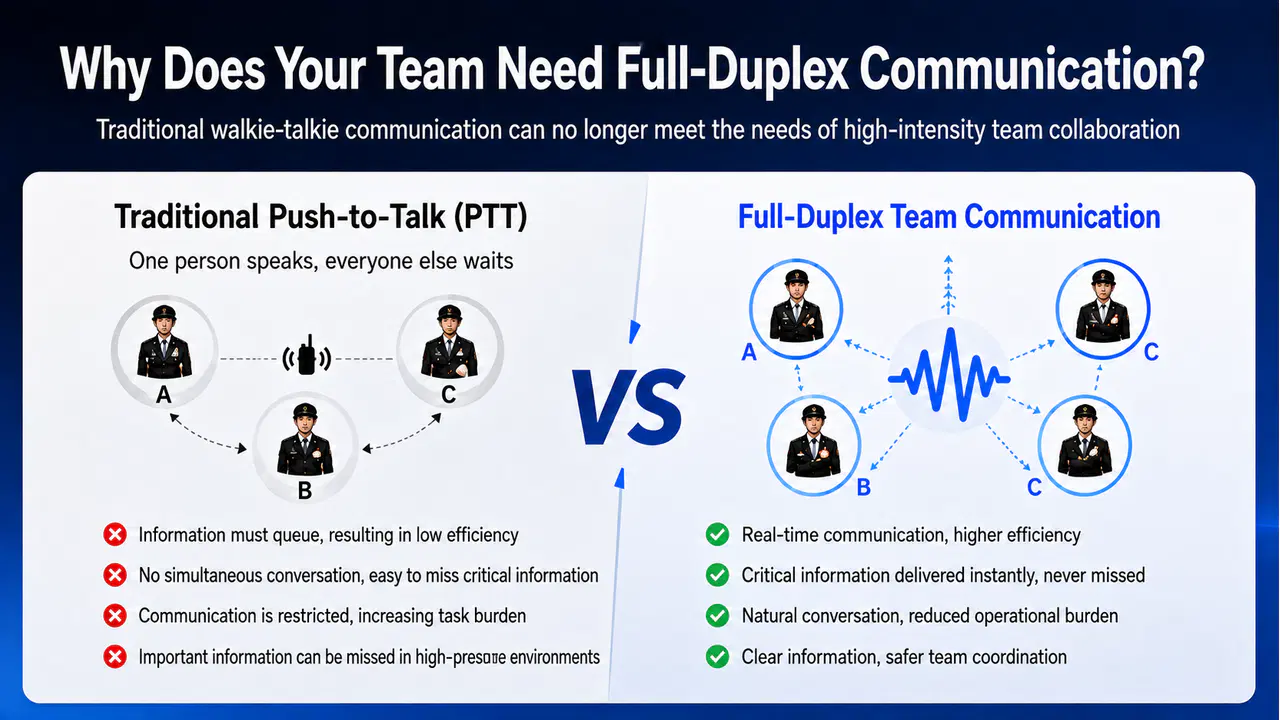
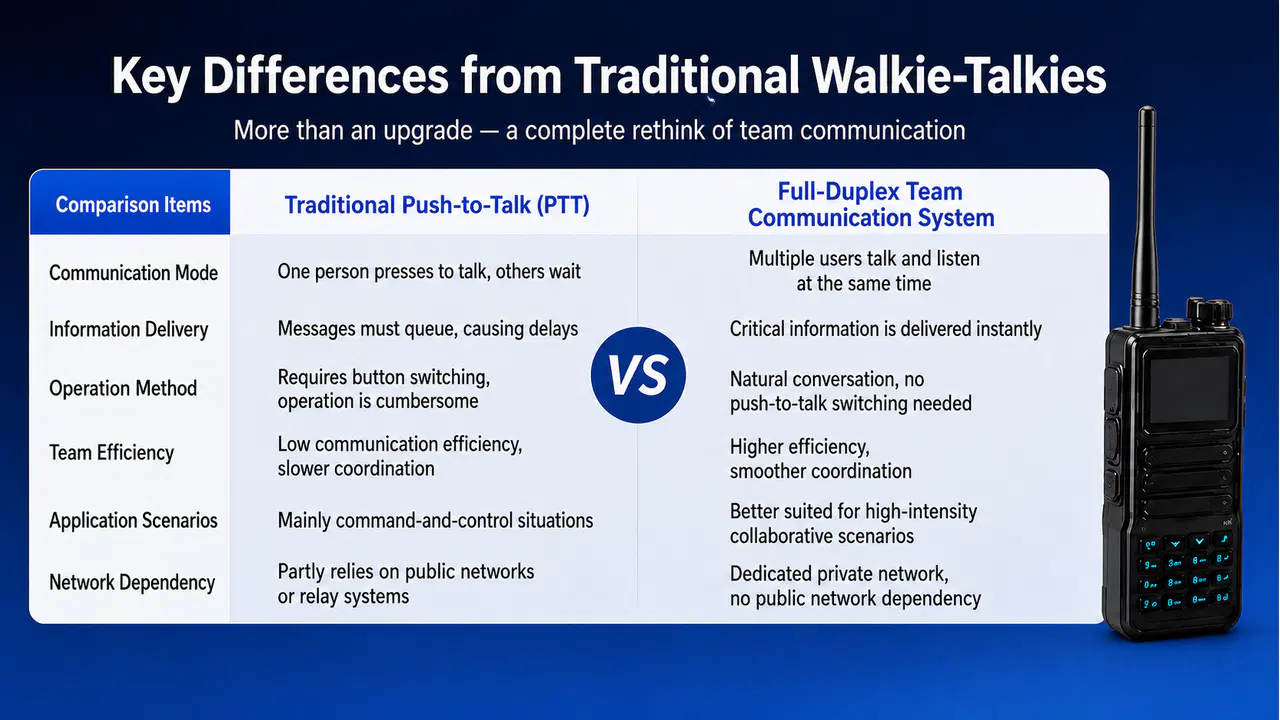
PRODUCT SOLUTION A professional Sub-1G private-network communication system that supports simultaneous two-way voice, independent group operation and locally controlled deployment for coordinated teams. One cluster gateway supports connection for up to 32 handheld terminals. Organize communication into as many as four independent groups without interference between groups. Each group supports simultaneous two-way voice for up to eight users. Build local team communication without depending on public-network coverage. Traditional push-to-talk communication allows one person to speak while everyone else waits, which can delay time-sensitive information and restrict natural conversation.
Full-duplex communication lets team members talk and listen at the same time, supporting faster coordination in high-intensity professional scenarios. The system combines low-latency full-duplex voice, microphone and speaker support, noise reduction, echo cancellation and Bluetooth headset compatibility.
Sub-1G wireless access and dedicated audio processing support clear and stable communication across complex working environments. Handheld terminals connect automatically to a cluster gateway that manages terminal groups and provides local network interconnection through Sub-1G wireless access.
The locally controlled architecture supports independent group communication without renting or depending on a public network. A single gateway supports 32 terminals, four independent groups and up to eight full-duplex users per group, with private network deployment and Sub-1G wireless access.
Hardware-based PUF authentication, enhanced audio technology and Bluetooth headset support provide secure and flexible operation for professional teams. Unlike traditional push-to-talk systems, full-duplex users can speak and listen simultaneously without button switching or queued messages.
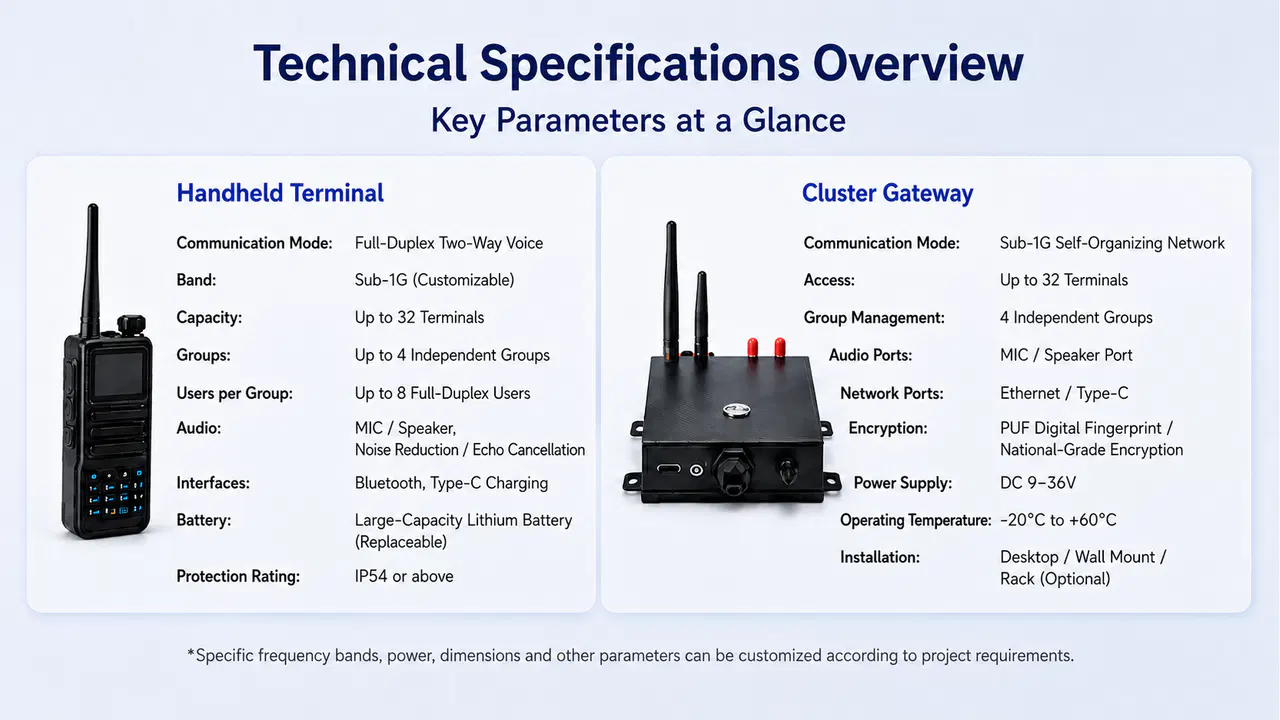
Immediate information delivery and smoother coordination make the system suitable for high-intensity collaborative work that requires locally controlled communication. The handheld terminal supports full-duplex two-way voice, Sub-1G operation, up to four groups, Bluetooth and Type-C charging, with audio enhancement and a replaceable lithium battery.
The gateway supports up to 32 terminals, four independent groups, microphone and speaker ports, Ethernet and Type-C connectivity, PUF-based encryption and DC 9–36 V power. The platform combines full-duplex communication, group management, stable wireless performance and advanced security in one locally deployable system.
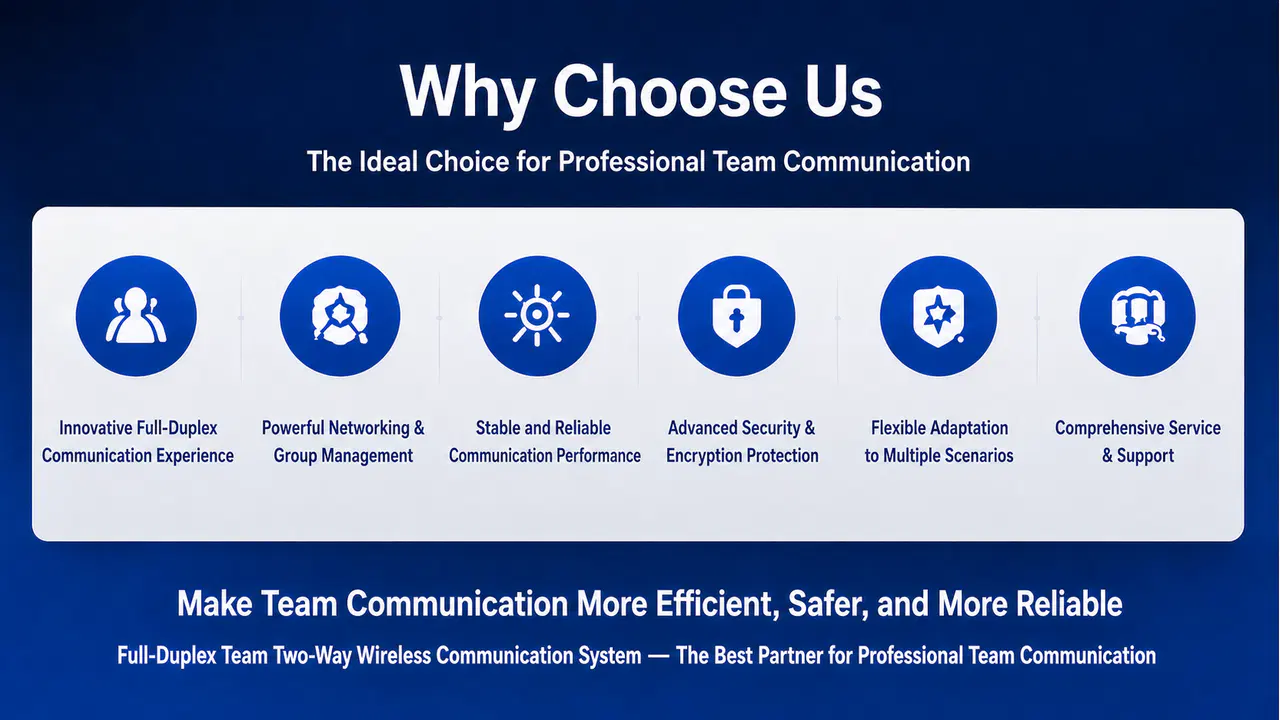
Flexible adaptation and service support help professional teams establish efficient, safer and more reliable communication for demanding applications. PROJECT SUPPORT Talk with a KingNeed specialist about the right configuration, integration and delivery requirements for your project.Full-Duplex Team Wireless Communication System

Key Features
Up to 32 Terminals
Four Independent Groups
Eight Full-Duplex Users
Private Sub-1G Network
Why Teams Need Full-Duplex Communication
Professional Audio and Connectivity Features

System Components and Operating Method

Key Functional Highlights

A Different Team Communication Experience
Technical Specifications Overview
Built for Professional Team Communication
Get pricing and technical details
Full-duplex wireless intercom: system planning
The published configuration uses a private Sub-1G network for simultaneous two-way team voice. One cluster gateway supports up to 32 handheld terminals, organized into as many as four independent groups, with up to eight full-duplex users per group.
What does full-duplex team communication mean here?
Users in a group can speak and listen simultaneously. The described configuration supports simultaneous two-way voice for up to eight users per group.
Are 32 terminals all in one eight-user conversation?
The product describes up to 32 handheld terminals connected to one cluster gateway and as many as four independent groups. Each group supports up to eight full-duplex users.
Does the system depend on public mobile-network coverage?
The described team voice configuration runs on a private Sub-1G network. Confirm the regional radio configuration and installation requirements for the project.
What should be confirmed before deployment?
Confirm the terminal and gateway arrangement, group assignments, local radio requirements, charging plan, and site coverage. The product page does not establish a universal range for every site.
Full-Duplex Wireless Intercom for Team Communication: Project Guide
Private Sub-1G full-duplex intercom supporting up to 32 terminals in four independent groups of up to eight simultaneous users. Review the team configuration.
Choose your project configuration
- Gateway and terminal quantities for each working team.
- Up to four independent groups and eight full-duplex users per group.
- Regional radio configuration and deployment layout.
For a quotation, share the installation market, planned quantity and site or host-equipment details. Agree the supplied model, interfaces, maintenance access and service scope.
Product and purchasing questions
Can all 32 terminals speak in one eight-user group?
The described cluster gateway supports up to 32 terminals organized into as many as four independent groups. Each group supports up to eight full-duplex users. Group structure and terminal capacity are separate planning values.
How many terminals can connect to a gateway?
One cluster gateway supports connection for up to 32 handheld terminals.
How are the independent groups arranged?
Organize communication into as many as four independent groups without interference between groups.