
Short answer: in a retail store or warehouse, a security fog / smoke system follows three steps — the alarm detects a security event, release is triggered (linked alarm, on-site button or mobile, per model), and smoke is released near protected assets to obstruct visibility. Each site must confirm room volume, airflow, mounting, evacuation and local rules first. See the KingNeed Anti-Theft Smoke Generator.
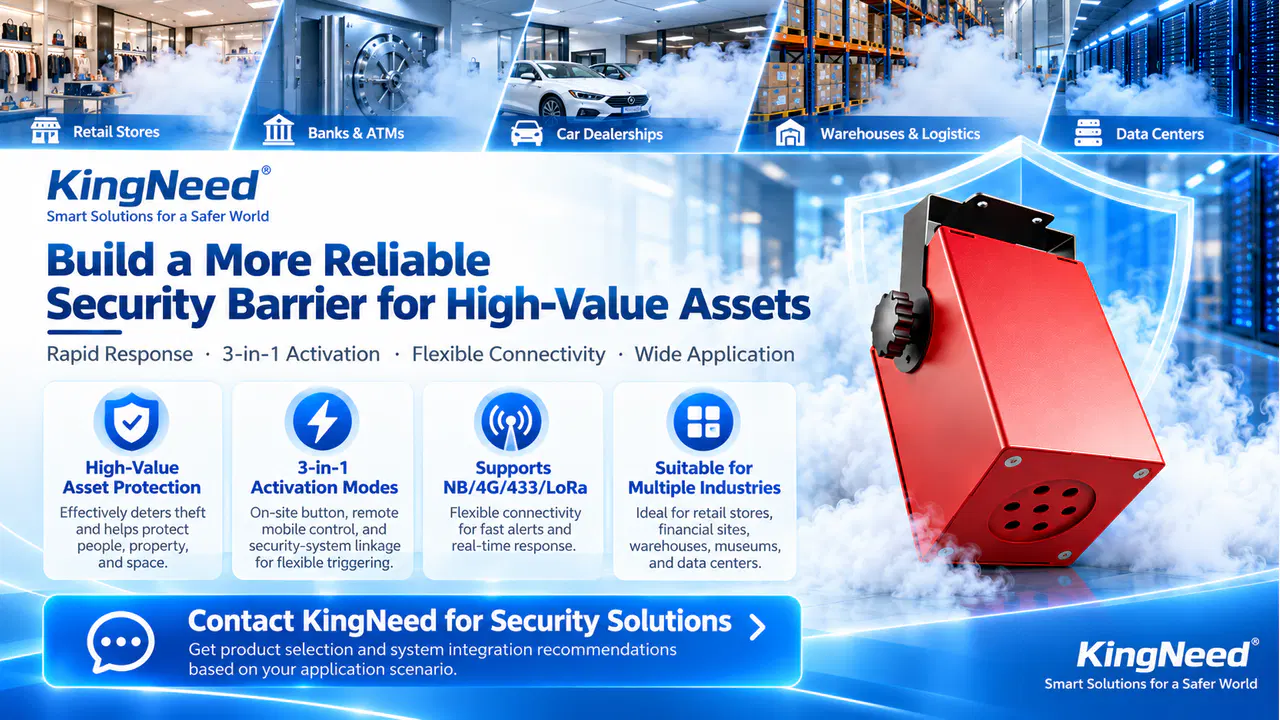
How it works in a retail store or warehouse
- Detect — the existing alarm or security system identifies a security event.
- Trigger — release is activated by the linked security system, an on-site button or remote mobile activation; confirm which are supported by each model.
- Release — smoke is released near the protected assets to obstruct visibility.
Actual smoke density, coverage, time to release and deterrence depend on the exact model, enclosure, room volume, airflow and installation.
Applications depicted for this product
The supplied images on the product page depict these as possible security applications:
- Retail stores
- Warehouses
- Data centers
- Offices
- Banks and ATMs
- Vehicle dealerships
Vehicle installations are also pictured; vehicle use requires a separate review of occupancy, ventilation and emergency egress conditions.
Site factors to confirm before planning
| Factor | Why confirm it |
|---|---|
| Enclosure, room volume and airflow | Listed on the product page as factors that affect smoke density, coverage and time to release |
| Mounting (wall, ceiling, vehicle) | Needs manufacturer-approved installation |
| Evacuation routes and bystanders | Part of the site-specific safety review for any occupied area |
| Fire detection and suppression | Interactions must be assessed before deployment |
| Activation path and network variant | Model-dependent; network bands require model and market review |
| Local rules and permitted use | Confirm with the manufacturer and local authorities |
Data centers and offices
Data centers and offices appear among the depicted applications. For these and any occupied areas, assess fire-detection and suppression interactions, smoke exposure, evacuation routes and local rules before considering deployment.
Site-by-site questions: banks and ATMs, vehicles, data centers
Can a security fog system be used at a bank branch or ATM?
Banks and ATMs appear among the applications depicted for the KingNeed Anti-Theft Smoke Generator. Before planning, confirm enclosure, room volume and airflow, evacuation routes and bystanders, the activation path supported by the model, and local rules and permitted use with the manufacturer and local authorities.
Can an anti-theft smoke generator be installed in a vehicle?
Vehicle installations are pictured, but vehicle use requires a separate review of occupancy, ventilation and emergency egress conditions. Mounting needs manufacturer-approved installation, and permitted use must be confirmed for each model and site.
Is smoke-based security suitable for a data center?
Data centers appear among the depicted applications. Before considering deployment, assess fire-detection and suppression interactions, smoke exposure, evacuation routes and local rules. Smoke density, coverage and time to release depend on the exact model, enclosure, room volume, airflow and installation.
What to send KingNeed
Site type, mounting preference, preferred network and your existing alarm or security platform. This lets a specialist discuss configuration, integration and delivery requirements.
Note: performance, permitted use and local rules must be verified for each model and site. This guide makes no safety, legal or performance claims.
Related guides
- How an Anti-Theft Smoke Generator Works with Existing Alarm Systems
- Activation Options: On-site, Mobile and Alarm-Linked Triggers
- Safety and Integration Considerations for Smoke Security Devices
Next step
See the KingNeed Anti-Theft Smoke Generator product page, then contact KingNeed with your site type, mounting preference, preferred network and existing alarm or security platform. Distributors and system integrators can request a quote the same way.