WATER VENDING PROCUREMENT GUIDE
Water Vending Machine Selection: 180L, 320L and Hydrogen Options
Choose a water vending machine by storage volume, replenishment rate, treatment configuration and local payment requirements. KingNeed offers a 180L single-tank model, a 320L dual-tank model and a configurable hydrogen-enrichment platform.
Compare storage and production separately
Tank volume describes stored water. Production describes how quickly the selected treatment system replenishes that storage under specified operating conditions. A 320L tank arrangement is not a promise of 320 litres per hour. Use expected peak demand, the refill pattern and confirmed production conditions to compare proposals.
| Configuration | Published storage or production information | Selection focus |
|---|---|---|
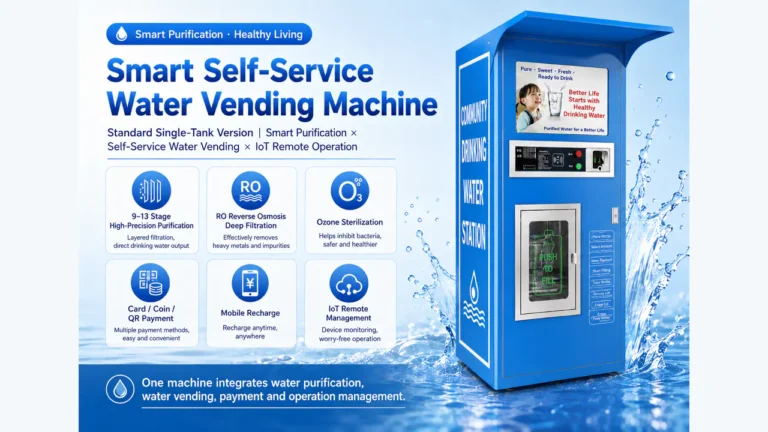
| 180L single-tank RO water vending machine | 180L storage and 120 L/h water production; the page describes a configurable 9–13 stage process with RO and ozone treatment. | Check the production conditions, expected refill demand and selected treatment components. |
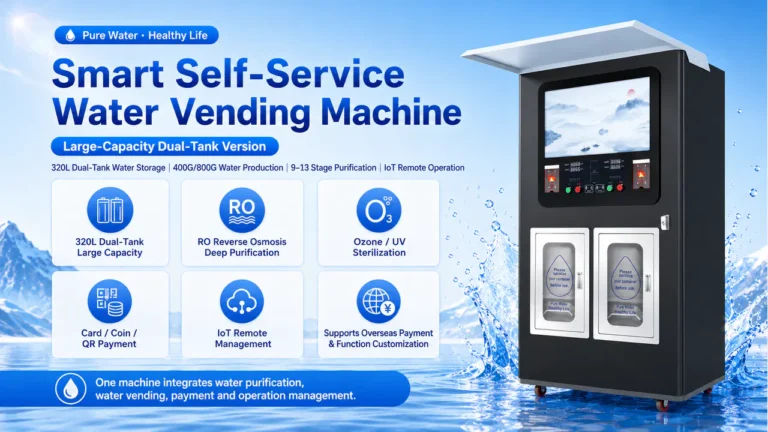
| 320L dual-tank RO water vending machine | Two 160L tanks provide 320L combined storage. The page separately lists 400G/800G production configurations. | Request the specification and output conditions for the chosen production configuration; do not convert the tank volume into an hourly output rate. |
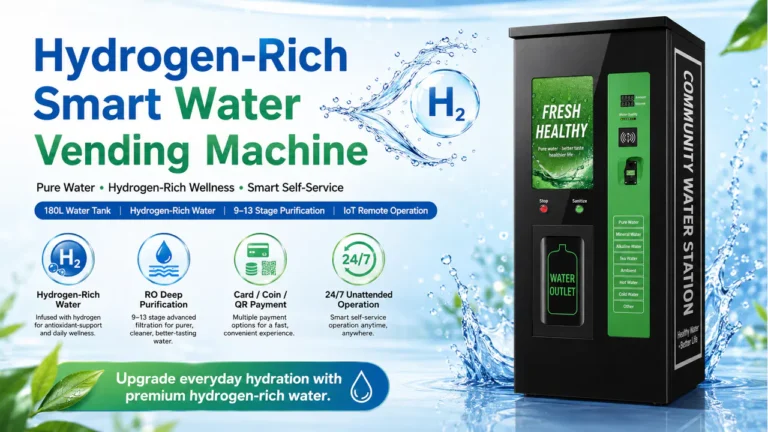
| Hydrogen-rich water vending machine | RO purification with configurable hydrogen enrichment and purified-water dispensing; remote equipment management is optional. | Confirm dispensing routes, enrichment hardware and measured output for the configuration offered. |
Match treatment to the source water
Provide available source-water information and the intended installation market before selecting a treatment arrangement. The published single-tank and dual-tank pages describe multi-stage purification; the offered stages and components should be specified in the quotation. Ask how water-output verification, cleaning, consumables and servicing will be handled for the proposed installation.
A stage count alone does not establish suitability for every source-water condition. Confirm the applicable local drinking-water requirements and the checks required for the actual supplied configuration before commercial operation.
Confirm payments, connectivity and operating functions
The standard single-tank page lists IC/ID water cards, coins, QR payment and mobile recharge. Confirm which payment modules and regional integrations are included in the offered machine rather than assuming every option is supplied together.
The dual-tank page describes remote parameter settings, monitoring, multi-machine management and operation-data analysis. The hydrogen-enrichment platform describes optional IoT functions for status, parameters, sales, water-output data and alerts. Ask which hardware, service connectivity and platform functions are included, and who will manage the payment and equipment accounts.
Prepare the installation and maintenance plan
- Describe the site. Supply the installation country, available space, service access, intended dispensing workflow and expected demand pattern.
- Confirm utilities. Ask for the selected model’s water supply, drainage, electrical, mounting and operating requirements. Check those requirements against the actual site.
- Agree the service scope. Identify cleaning procedures, consumable replacement, spare parts, commissioning checks and local maintenance responsibilities in the quotation.
These are procurement checks, not universal installation ratings. Request the model-specific dimensional drawing, utility schedule and supplied configuration before completing the site design.
Evaluate hydrogen enrichment by measured specifications
For the hydrogen-rich platform, confirm the selected enrichment equipment, dispensing arrangement and any optional remote-management functions. Request measured hydrogen concentration and the test conditions for the configuration being proposed. The public product page does not establish one concentration, retention time or health benefit for every machine.
Compare the selected platform with a standard RO water vending machine on the same site, payment and service requirements. Keep output specifications separate from unsupported health or revenue assumptions.
Questions to resolve before a quotation
Does a larger tank guarantee higher hourly output?
No. Tank storage and production rate are different quantities. Compare both against the refill pattern and request production conditions for the selected configuration.
Are all listed payments and IoT functions included?
No single configuration should be assumed to include every listed option. Confirm regional payment support, hardware, connectivity and platform functions in the quotation.
Which documents should I request?
Request a model-specific specification, dimensional and utility information, the proposed treatment and payment configuration, maintenance requirements and commissioning checks. Do not treat this guide as a replacement for the supplied technical documents.
Send a complete water vending enquiry
Share the installation country, expected peak demand and refill pattern, source-water information, preferred tank arrangement, payment requirements, remote-management needs and purchase quantity. KingNeed can discuss a configuration against the selected product scope.