
Compare KingNeed distributed solar-storage options by installation location, retrofit scope and assembly model before selecting a project configuration.
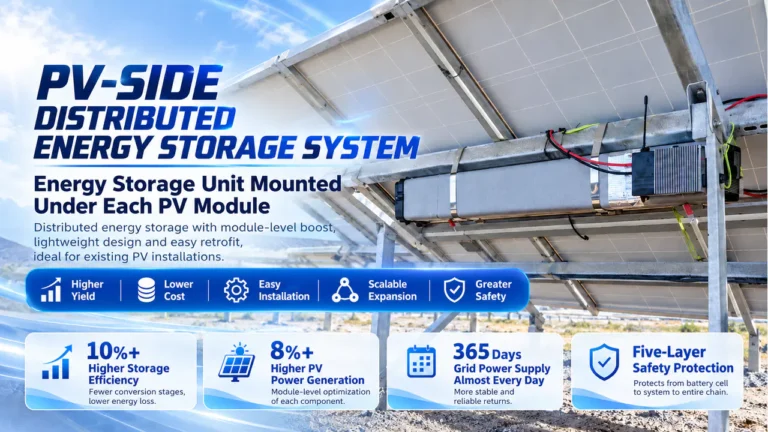
PV-side distributed system
The PV-side product presents component-level storage with modular deployment and selected retrofit planning. EMS scheduling, edge computing, wireless communication and illustrated safety components depend on the chosen configuration. Confirm what is included in the proposed system.
Panel-level DC storage
The panel-level product describes low-voltage DC storage beneath selected PV panels, with staged expansion and applications including telecom sites and commercial rooftops. Provide the existing installation topology so the supplier can review integration requirements.
Distributed PV storage bar
The storage bar places distributed storage close to selected PV modules and supports phased project planning. For eligible projects, discuss separated components and local assembly alongside a complete supply route.
Compare on the same project basis
Request comparable proposals for the same selected panels, operating objectives, installation conditions and integration boundary. Ask for confirmed capacity, electrical limits, controls and commissioning requirements. The public concept pages do not support a universal capacity, savings percentage or compatibility promise.
Relevant KingNeed products
- PV-Side Distributed Energy Storage System
- Panel-Level Distributed DC Energy Storage System
- Distributed PV Energy Storage Bar
Review the Distributed Solar Energy Storage selection page.
Module-level low-voltage DC micro storage vs conventional centralized storage
The product documentation contrasts module-level low-voltage DC micro storage with conventional centralized storage across land, grid process, safety, efficiency, response, usable capacity, generation, deployment flexibility and O&M. The figures below are stated in that documentation; they are not presented here as third-party laboratory results.
Comparison table
The following table follows Table 2 in the Module-Level Low-Voltage DC Micro Energy Storage System documentation (Rev. 2).
| Comparison dimension | Conventional centralized storage | Module-level low-voltage DC micro storage |
|---|---|---|
| Land requirement | Separate land acquisition required; difficult and lengthy approval; high civil works cost | Zero footprint, mounted beneath PV panels; no land approval |
| Grid process | Grid-connected equipment; grid approval and grid-connection testing required; complex and costly | Non-grid-connected DC-side equipment; no grid approval or testing; plant decides autonomously |
| Safety risk | Cells stacked centrally with high energy density and high thermal runaway risk; a single fault can take down the whole plant | Decentralized small modules; faults isolated at a single point; major-incident probability effectively zero; zero fire incidents in operation |
| Conversion efficiency | Four energy conversions plus thermal-management self-consumption; overall efficiency about 80% | Two direct-DC storage conversions with no self-consumption; overall efficiency above 92%, a gain of 10%+ |
| Response speed | Several minutes to switch charge/discharge; hard to match the grid dispatch rhythm | Edge-computing on-site response; switching completed in 1–3 seconds; precise tracking of dispatch instructions |
| Usable capacity | Many series-connected cells with a strong barrel effect; only about 80% of rated capacity can be delivered | 20-cell small modules deliver 95%–99% of rated capacity; usable energy 15%+ higher |
| Generation gain | No generation optimization; module mismatch cannot be addressed | Built-in module-level MPPT; 8%–20% additional generation from solar panels |
| Deployment flexibility | Built in a single phase; capacity cannot be adjusted flexibly; assets cannot be relocated | Modular, plug-and-play; capacity added or reduced on demand; flexible relocation and reuse |
| O&M cost | Professional high-voltage O&M team required; periodic liquid-cooling replacement is costly | Simple low-voltage O&M; single unit replaced separately; no liquid-cooling maintenance cost |
Direct DC path and generation gain
Under-panel low-voltage direct DC storage sends DC from the PV module into the storage unit directly, with two key conversion stages rather than the conventional four-stage path of PV DC → AC inversion → step-up → rectification to DC → storage battery. The documentation states overall charge/discharge efficiency above 92%, versus about 80% for the conventional path, and more than 10% additional usable energy for the same generation volume. The design uses natural cooling and does not rely on air-conditioning or liquid-cooling self-consumption equipment.
Built-in module-level MPPT independently adjusts the I-V curve of every PV module and isolates underperforming modules, typically increasing generation by 8%–20%, especially in cloud-shadow, heavily shaded C&I and complex-terrain mismatch conditions. A heavily shaded plant in Chongqing measured an increase of more than 15%.
Related reading
- PV-Side Distributed Energy Storage System
- How Module-Level Solar Storage Works
- Solar Storage Project Cost Factors
- Distributed Solar Storage FAQ
- Distributed DC Micro Storage for Modular Energy Architectures
- Add Storage to an Existing Solar PV System
Frequently asked questions
How does module-level low-voltage DC micro storage differ from conventional centralized storage?
The product documentation contrasts module-level low-voltage DC micro storage with conventional centralized storage across land, grid process, safety, conversion efficiency, response speed, usable capacity, generation gain, deployment flexibility and O&M cost. Units are described as zero-footprint equipment mounted beneath PV panels, as non-grid-connected DC-side equipment, with overall charge/discharge efficiency above 92% versus about 80% for the conventional multi-stage path, and with charge/discharge switching completed in 1–3 seconds rather than several minutes. See the PV-Side Distributed Energy Storage System for the selected configuration.
What generation gain does the documentation describe for module-level MPPT?
The documentation describes built-in module-level MPPT that typically increases generation by 8%–20%, especially under cloud shadow, heavily shaded C&I rooftops and complex-terrain mismatch. A heavily shaded plant in Chongqing measured an increase of more than 15%.